Automation Systems: The Power Transforming Production and Daily Life in a Digitalized World Today, technology has advanced to the point where automation systems have become indispensable in nearly every aspect...
Automation Systems: The Power Transforming Production and Daily Life in a Digitalized World
Today, technology has advanced to the point where automation systems have become indispensable in nearly every aspect of life. Broadly speaking, automation aims to minimize human intervention in processes by predefining decision criteria and associated actions. From industrial facilities to healthcare services and smart home solutions, automation leaves its mark everywhere. The primary purpose of these systems is to consistently and reliably enhance production and service quality by reducing the human factor to a minimum.
What Exactly Is Automation, and Why Is It Critical in Our Production Processes?
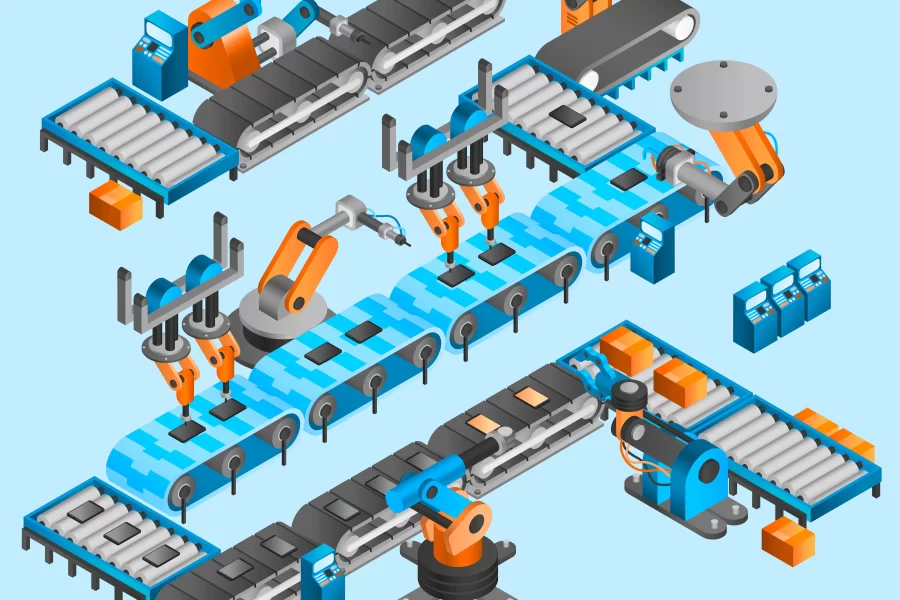
Automation is not just about performing tasks faster; it involves managing production processes through machines, software, and control systems without requiring human intervention. Industrial automation plays a key role in helping businesses achieve critical objectives such as speed and agility. In a competitive environment with rising energy costs, companies need to produce more and higher-quality output with fewer resources, and this is where automation systems step in.
In manual processes, performance can be affected by distractions, fatigue, and other human factors. Automation systems, however, perform the same tasks continuously with standardized quality and speed. This consistency increases production volume, maintains quality, and significantly reduces the rate of defective products, boosting customer satisfaction.
Why Has Industrial Automation Become a Necessity? Linking Efficiency and Cost
Industrial automation is not just a means to reduce costs; it directly impacts productivity and sustainability goals. Smart automation systems optimize energy consumption by ensuring machines operate only when needed, leading to significant savings in electricity, gas, and other operational expenses.
We all know how rapidly market dynamics change, and customers continually demand new products. Automation allows production lines to quickly adapt to different product types, enabling continued production without long downtime and increasing operational agility.
The Building Blocks of Production Systems: How Is Control and Interaction Achieved?
Industrial automation is complex, generally comprising three main subsystems:
-
Industrial Control Systems: Regulate operating conditions based on logical rules.
-
Industrial Automation Systems: Ensure operations maintain target performance despite disturbances.
-
Industrial Data Communication Systems: Provide reliable and rapid transfer of information.
In critical infrastructures, data communication systems using specialized software like SCADA (Supervisory Control and Data Acquisition) play a key role in process monitoring, remote operation, and control.
PLCs: Programmable Logic Controllers – The Brain of Production Lines
The Programmable Logic Controller (PLC) is the primary device handling control, command, and data communication in modern industrial automation systems. PLCs manage fundamental control functions using timers, counters, and comparison operators.
Programs are commonly written in Instruction List (IL), Structured Text (ST), or graphical Ladder Diagram (LD) languages. For example, the LD command checks a “1” signal (normally open contact), while LDI checks a “0” signal (normally closed contact). These commands enable everything from simple functions—like turning a motor on/off or filling a tank—to managing complex processes.
Human-Machine Interfaces (HMI) are vital in field operations to monitor system performance, locate faults, or track production quantities. HMIs serve as the contact point between users and machines, incorporating visual screens, touch panels, and buttons. Intuitive HMI design enhances usability, increases efficiency, and reduces errors.
Automation Beyond Physical Processes: What Role Does Robotic Process Automation (RPA) Play?
Automation is not limited to physical robots; it also encompasses fully software-based transformations of business workflows. Robotic Process Automation (RPA) uses software robots to automate rule-based, repetitive tasks. RPA captures the manual actions performed by humans across digital platforms and replicates them efficiently and consistently.
RPA bots can automate tasks across applications without needing to develop code or access databases directly. Common applications include data entry, data collection, and invoice processing, freeing employees to focus on higher-value activities, boosting both morale and productivity.
How Does RPA Handle Software Tasks?
RPA handles high-volume, repetitive, rule-based tasks such as extracting/processing data from Excel, managing emails, filling forms, or generating periodic reports.
RPA solutions generally consist of three main components:
-
Development Environment: Where processes are designed.
-
Robots: Virtual workers executing tasks.
-
Control Panel: Monitors and manages operations.
Robots are typically categorized into:
-
Attended Robots: Assist individual users in low-volume office tasks interactively.
-
Unattended Robots: Operate independently in back-office processes, executing long tasks from start to finish.
-
Hybrid Robots: Combine attended and unattended capabilities, often enhanced with AI.
RPA can integrate with ERP (Enterprise Resource Planning) and other systems to manage end-to-end process automation.
The Vision of the New Era: Industry 5.0 and Human-Centered Automation
While Industry 4.0 focused on increasing efficiency through digital connectivity and AI, the new era of Industry 5.0 takes a human-centered approach. Its pillars are sustainability, resilience, and human-centricity.
Where Industry 4.0 emphasized profit and cost optimization, Industry 5.0 aims for collaboration between human intelligence and creativity with artificial intelligence. Automation now addresses not only efficiency but also societal welfare and environmental responsibility.
This perspective profoundly affects marketing and production strategies. Whereas previous industrial eras focused on mass production, Industry 5.0 emphasizes mass customization. Customers now demand highly personalized products and experiences. Automation systems must integrate advanced technologies such as AI and machine learning to deliver personalized, human-centered marketing campaigns and meet individual consumer needs efficiently.
Industry 5.0 opens doors to new career fields that value continuous learning, design, and process improvement capabilities.