
What Is Industry 5.0 and Why Is It Being Discussed Now?
Industry 5.0 is a framework proposing that manufacturing be judged not only on efficiency and cost but along three axes: people, sustainability and resilience. It spread through the policy documents published by the European Commission in 2021, and it is a direction of travel rather than a technical standard.
The reason it came onto the agenda is practical. The Industry 4.0 wave made connected machines, data collection and automation widespread; but the pandemic, supply chain disruptions, energy costs and the shortage of qualified labour showed that a production model focused on efficiency alone is fragile. Industry 5.0 can be read as a correction seeking an answer to that fragility.
One point deserves emphasis: Industry 5.0 is not a generation that replaces Industry 4.0. There can be no talk of “human-centred smart manufacturing” before the data, connectivity and automation infrastructure is in place. The two do not run in sequence; they run inside one another. We covered that first layer of digital transformation in our article on Industry 4.0 in robotics.
What Is the Difference Between Industry 4.0 and Industry 5.0?
The fundamental difference lies in the question itself. Industry 4.0 asks “how can this process run more efficiently?” Industry 5.0 adds three constraints to the same question: how does it get better for the employee, how does it cost less in resources, and how does it stay standing in a crisis?
In practice that means not a change of technology but a change in the measure of success. The same robot cell is judged, under an Industry 4.0 lens, on cycle time and output; under an Industry 5.0 lens it is judged additionally on ergonomics, energy consumption, changeover flexibility and employee competence.
The meaning of automation shifts too. Where Industry 4.0 discourse often framed automation along the axis of “replacing people”, Industry 5.0 frames it along the axis of extending what people can do. The division of labour is redefined between the areas where humans are strong (judgement, adaptation, problem solving, experience) and the areas where machines are strong (repetition, endurance, precision).
What Does Human-Centricity Look Like on the Production Line?
Human-centricity sounds abstract but has very concrete equivalents on the floor. It becomes visible through questions like these:
- At which stations do repeated heavy lifting, pushing and overhead reaching concentrate across a shift?
- Which jobs are the source of musculoskeletal complaints and of people leaving?
- Can the operator understand from the screen what the machine is doing, or does the system look like a closed box?
- When a fault occurs, can the operator intervene, or is waiting the only option?
In a human-centred automation design the priority is not to automate the highest value-adding work but to hand over the most wearing and most repetitive work. Palletizing heavy boxes, taking parts from a hot machine, and handling material in a dusty environment all fall into that definition. We discussed the production-line equivalent of this view in our article on the new era of human-robot collaboration, and its effect on the workforce in our article on steel collar robots.
Field note: The clearest indicator of human-centred automation is that after commissioning the operator works with the system rather than against it. In projects where the people who will run the cell were not consulted during design, even technically flawless installations run at low utilisation in the first months.
Where Do Cobots Sit Within Industry 5.0?
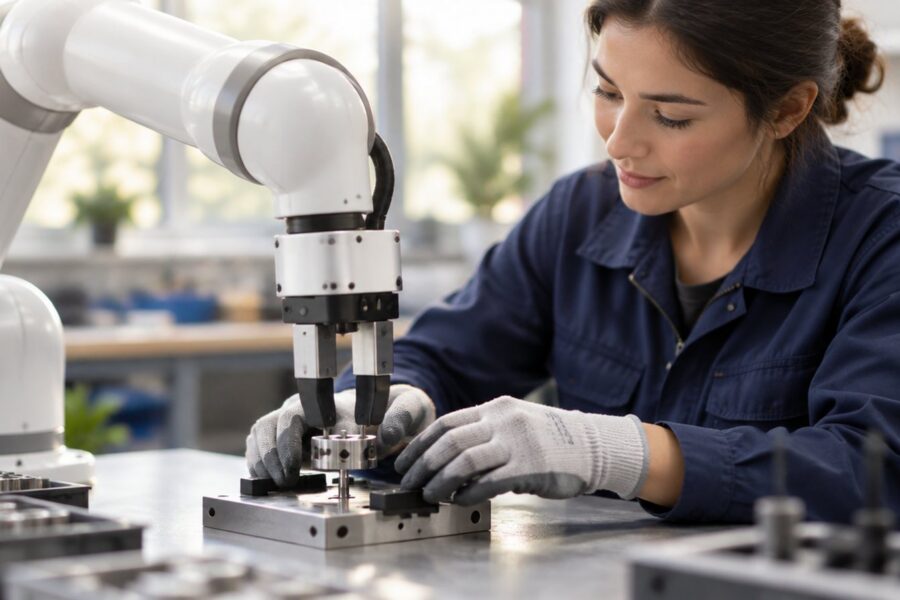
Collaborative robots (cobots) are the most visible technical expression of the human-centricity principle. Unlike a classic fenced robot cell, a cobot is designed so that — when the risk assessment supports it — it can share the same space as the operator: force and speed limiting, rounded surfaces and contact detection are all part of that design.
What makes a cobot emblematic of Industry 5.0, however, is not the absence of a fence. The real difference is the rebuilding of the division of labour: the robot takes on the repetitive and tiring part while the operator stays with inspection, adjustment and exception handling. The two work together at the same station.
A realistic note is needed here. A cobot is not the answer to every application; it generally works with lower payload and lower speed, and when its speed is limited for safety reasons the cycle time can stretch. We compared when a cobot and when a classic industrial robot is the right choice in our article on industrial robot or cobot; for the general framework of collaborative working, see our article on collaborative robots.
How Does Sustainability Stop Being a Slogan?
The second axis of Industry 5.0 is sustainability, and in manufacturing it has measurable equivalents. The most direct item is the scrap rate: every part produced defective means the material, the energy and the labour spent on it all go into the bin. Catching a defect early in the line is therefore a question of both quality and resource efficiency. How in-process inspection is set up is described in our article on quality control with robotic machine vision.
The second item is the relationship between energy and downtime. Infrastructure such as heating, cooling and compressed air keeps running even when the machine is not producing; idle time turns energy into an overhead that cannot be divided across product. Every improvement that raises equipment effectiveness therefore also lowers energy consumption per unit produced. We set out the measurement method in detail in our article on calculating OEE.
The third item is material usage: consistent parameters in robotic applications reduce consumable use and excess material. We covered the holistic frame of the subject in our article on the environmental impacts of robotic automation.
Resilience: How Is Flexible Production Built for a Crisis?
The third axis, resilience, is the capacity of a production system to stay standing when it meets an unexpected shock. The shock may be a supplier missing a delivery; it may equally be a sudden jump in demand, a power cut, or a key operator leaving.
Resilience has concrete equivalents on the production line: how long a product changeover takes, whether the flow has an alternative path when one station stops, and whether critical knowledge sits in one person’s experience or in a written procedure.
Automation works in both directions here. Designed correctly it increases resilience: because process knowledge is written into programs and parameters, dependence on individuals falls and quality is not affected by staff turnover. Designed incorrectly it increases fragility: a line dependent on a single special-purpose machine, where changeover takes hours, locks the business up the moment demand shifts.
The decisive question is this: when a new product arrives, in how many hours can the system be brought into production? The answer to that question is the most honest indicator of a line’s resilience. How commissioning time is shortened is shared in our article on how long robot installation takes.
What Does Industry 5.0 Mean for SMEs?
Frameworks like this are usually read as the agenda of large manufacturers; in fact all three axes have a more direct meaning for small and medium-sized businesses.
The human axis: for a business that struggles to find qualified operators, handing over the wearing jobs is not a comfort choice but a staff retention strategy. The sustainability axis: the environmental reporting that large customers demand from their suppliers is steadily becoming a condition of market access for smaller suppliers. The resilience axis: for a manufacturer dependent on one large customer, a flexible line is the capacity to win new customers.
The right start for an SME is not to declare a large transformation programme but to measure a single bottleneck and begin there. We covered the effect of automation on small and medium-sized businesses in our article on what SMEs gain with automation, and compiled the available investment support in our article on government incentives and grants.
Which Investment Is the First Step in the Transition?
The first step towards Industry 5.0 is not a machine but a measurement. An investment made without knowing which station is the most wearing, which machine stops most often and which product changeover takes longest rests on guesswork.
Once the measurement is complete, the next step is to select the single highest-impact point. Experience shows that projects trying to transform the whole line at once usually stall halfway, while projects that start at one station and grow by measuring the result tend to last.
The third step is validating the decision before commissioning. Whether the new arrangement will work in the existing layout, whether the cycle target will hold and how the operator’s flow will change can all be seen during the site survey and simulation stage.
How Do Employee Skills Change?
This is the most misunderstood part of the automation debate. What is actually observed on the floor is less the disappearance of work than a change in the content of the work: the person who carried parts by hand becomes the person who sets up the cell, adjusts the parameters and diagnoses deviations.
That transformation does not happen by itself. In systems commissioned without a training plan, operators prefer to stop the system and wait when a fault occurs; availability falls and the investment does not deliver the expected result. How an in-house training programme is designed is covered in this article, and the career path on the maintenance side in our article on robot maintenance technician training.
How to Test the Industry 5.0 Narrative on the Floor
The fastest way to tell whether a concept is working is to convert it into measurable questions. For Industry 5.0 those questions are:
- At which stations has ergonomic load fallen over the last year, and did we measure it?
- In which direction are our energy use and scrap rate per unit produced moving?
- How long did it take to bring a new product onto the line last year, and how long does it take today?
- When a critical operator leaves, for how many days is production affected?
If the answers to these four questions improve over the years, the business is moving in the direction of Industry 5.0 whether or not it uses the label. If there are no answers, the framework is still only a slide title.
Industry 5.0 is, in the end, less a new generation of machines than a new set of questions: taking the employee, the resources and the capacity to adapt into account while raising efficiency. To see what those questions mean for your own line, you can start with the project management step; for scenarios where people and robots work at the same station, review our cobot CNC automation systems and cobot palletizing systems pages.