
What Is a Cartesian Robot?
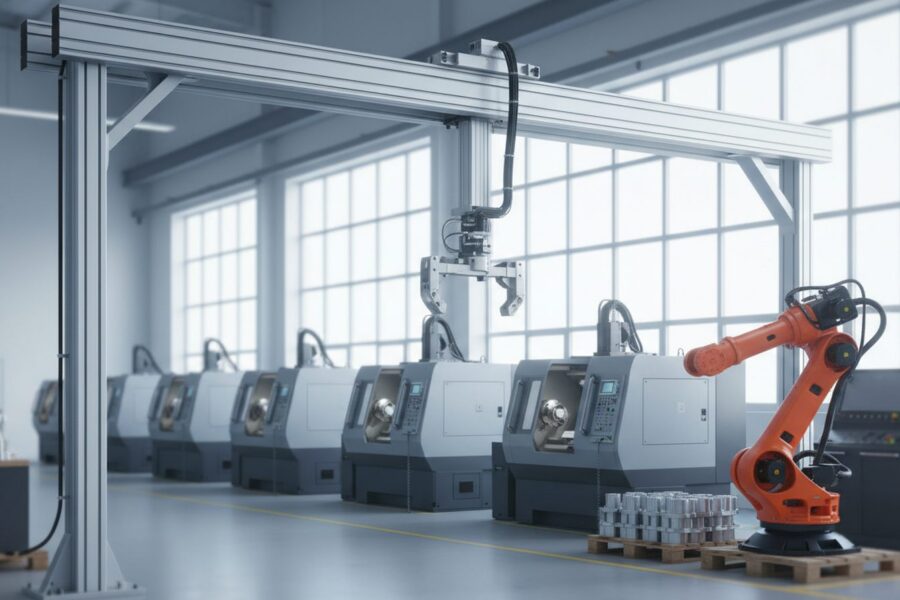
Quick answer: A Cartesian robot is an industrial robot that moves along three linear axes (X, Y and Z) set at right angles to each other. It reaches a position by sliding along rails rather than rotating, so its motion is as simple as moving to a point in a coordinate system. The large version, built with an overhead bridge, is called a gantry robot.
The name comes from the Cartesian coordinate system, which defines a position with X-Y-Z coordinates. In an articulated robot arm, the position of the tool is calculated from all the joint angles together; in a Cartesian robot, each axis handles a single direction. The result is predictable, rigid motion with high repeatability over long distances.
Most workshops already have everyday examples: CNC routers, 3D printers and plotters all use Cartesian kinematics. An industrial Cartesian robot is the same principle with a gripper or tool mounted at the end.
How Does a Cartesian Robot Work and What Is It Made Of?
A Cartesian system is built from four main components:
- Linear axes: Each axis is a carriage sliding on a rail or profile. Motion is transmitted by a ball screw, a belt and pulley, or a rack and pinion. Ball screws are preferred for short, precise strokes; belts or racks for long, fast strokes.
- Motors and drives: Each axis usually has a servo motor, with position read from the motor encoder.
- Controller: Coordinates the axes; in most applications a PLC or a motion control card does this job.
- End effector: A vacuum gripper, mechanical gripper, dispensing head or tool. If the part needs to be rotated, an additional rotary axis is added at the end.
The design is modular: axes are selected from standard profiles and combined to fit the application. Enlarging the work area often simply means lengthening an axis. This is the strongest side of a Cartesian system, but it also means every project needs some degree of custom mechanical design.
Are Gantry Robots and Cartesian Robots the Same Thing?
A gantry robot is a subtype of Cartesian robot. The difference is in the support structure: in a classic Cartesian system the axes can be supported from one side (cantilever type), while in a gantry the horizontal axis is carried at both ends, on two legs or two rails, forming a bridge above the work area.
The bridge structure makes heavy loads and large areas possible. That is why gantry systems appear in overhead loaders serving several machine tools, in large pallet areas and in transfer along long lines. The trade-off is a large steel structure fixed to the floor or ceiling, and a layout that is frozen around that structure.
The terms “portal robot”, “XYZ robot” and “linear robot” are often used for the same family.
What Are the Differences Between a Cartesian Robot and a Robot Arm?
The two approaches are not rivals; they answer different problems. The table below puts the deciding criteria side by side:
| Criterion | Cartesian / Gantry Robot | Articulated Robot Arm |
| Motion structure | Three linear axes (X, Y, Z) | Usually 6 rotary axes |
| Work envelope | Rectangular; enlarged by extending an axis | Spherical; limited by the arm’s reach |
| Part orientation | Limited; needs an extra rotary axis | Can position the part from any angle |
| Floor use | Works from above; can keep the floor free but needs a large frame | Small footprint; needs a safety zone around it |
| Programming | Simple kinematics; mostly via PLC | Robot controller with its own programming environment |
| Layout changes | Require mechanical redesign | Possible through reprogramming and relocation |
| Strength | Large areas, straight-line motion, heavy and fixed tasks | Flexibility, complex motion, frequent product changes |
| Weakness | Angled approach, reaching inside a machine | Very large areas, long linear strokes |
We compared where other robot types such as SCARA and delta robots stand next to articulated robots in our article what types of industrial robots are there.
When Is a Cartesian System the Better Choice?
Cartesian and gantry systems come out ahead when most of the motion can be done in a straight line and from above. Typical examples:
- Overhead loading of multiple machines: Layouts where a single portal system feeds a row of lathes from above. If the part can be lowered vertically into the machine, one long X axis can serve several machines.
- Pick and place over a large area: Tasks where products taken from a conveyor are placed across a wide area and the motion consists of horizontal and vertical components.
- Dispensing, gluing and cutting: Applications where the tool follows a path over a surface with a fixed orientation.
- Single-product, fixed lines: Plants where the same product is processed in the same layout for years and the layout is not expected to change.
What these have in common is a fixed task and simple geometry. As product variety grows, the advantage shrinks, because every new scenario has to be solved within the limits of the mechanical structure.
When Does a Robot Arm Come Out Ahead?
Placing a part at an angle into a machine chuck, reaching through a door opening into a machine, or flipping a part to machine its second side quickly reveal the limits of a Cartesian structure. A six-axis robot arm performs these motions without additional mechanical design.
The second advantage of a robot arm is reusability. An arm that tends a CNC machine today can be reprogrammed to palletize at another station when the product reaches end of life. In a Cartesian system, the same change often means a new structure. For plants with frequent product changes, small batches or plans to expand the line, this flexibility is decisive.
The same logic applies to palletizing: a portal palletizer can do the job for a single product and a fixed pattern, while a robot arm takes the lead with varying case sizes, changing patterns and tight floor space. You can find a palletizing-specific comparison in our article how to choose the most suitable robot type for palletizing, and our robot-based end-of-line solutions on the industrial palletizing systems page.
Field note: In most projects where the choice between a Cartesian system and a robot arm is unclear, the deciding question is not “today’s part” but “the product range three years from now”. A fixed structure sized only for today’s job may require a new investment at the first product change.
Linear Axis + Robot Arm: When Does a Hybrid Make Sense?
The two worlds are not always separate. Mounting a robot arm on a linear track, or adding an external vertical axis, combines the linear reach of a Cartesian system with the flexibility of a robot arm. This setup is commonly called the “7th axis”.
A hybrid makes sense in two situations: when the robot must serve an area too large to reach from a single point (for example several machines side by side), or when vertical reach must be increased to access high pallet layers. For example, Rocobot End of Line Cobot combines a reach of 1889 mm with an external vertical 7th axis to handle case packing and palletizing at the end of the line.
An extra axis brings additional mechanics, an additional safety assessment and an additional maintenance item. So the first question should always be “is standard reach enough?”; if it is, the extra axis is unnecessary complexity.
Which Questions Should You Ask Before Choosing?
When deciding between a Cartesian system, a robot arm or a hybrid, the following questions narrow the path considerably:
- Can the part be picked and placed only from above, or does it need an angled approach or flipping?
- Does the area to be served fit within the reach of a single arm?
- What is the total load including the gripper, and which part is the heaviest?
- Will the product range and layout change over the next few years?
- Is floor space the scarce resource, or are ceiling height and overhead access restricted?
- From where and how will operators and the maintenance team access the system?
The answers depend more on the real layout and the actual cycle time than on catalogue values. The right approach is to validate the choice with site data and simulation during the project management phase, so that reach, cycle time and safety zone are seen together before any structure is built.
Frequently Asked Questions
How many axes does a Cartesian robot have?
The basic structure is three linear axes (X, Y, Z). If the part needs to be rotated, one or two rotary axes are added at the end, giving a four- or five-axis system.
Is there a difference between a gantry robot and a portal robot?
In practice they describe the same structure: a bridge supported at both ends above the work area, with axes moving along it. “Gantry” is more common in international literature, “portal” in some European markets.
Which is more precise, a Cartesian robot or a robot arm?
There is no single answer. Thanks to its rigidity, a Cartesian structure provides consistent positioning over long linear strokes, while the repeatability of a robot arm depends on the model and load conditions. The comparison should be made using manufacturer values for the same load and the same work area.
Which one is used for CNC machine tending?
Both are used. If the part can be lowered vertically into the machine and several machines are lined up side by side, overhead portal loading may be suitable. If the part has to be placed at an angle, flipped, or the arm has to reach through a door opening, a robot arm offers a more flexible solution.
Can a Cartesian robot work as a cobot?
Cartesian systems usually work in an area separated by guarding or sensors. If people need to share the same space, collaborative robot arms designed for that scenario, together with an application-specific risk assessment, are a better starting point.