
What Is an AGV and How Does It Find Its Way?
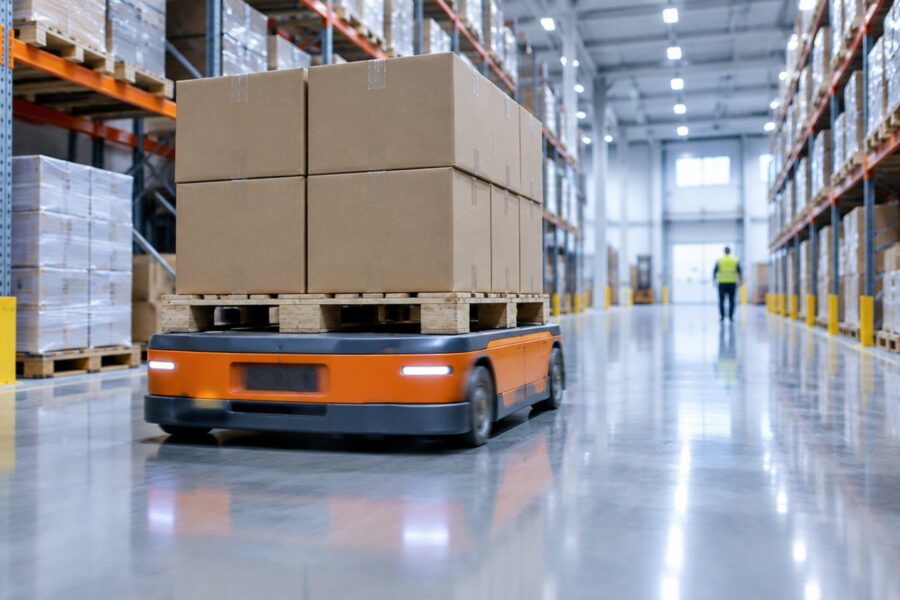
An AGV (Automated Guided Vehicle) is an autonomous transport vehicle that moves along a fixed, predefined route inside a facility. The route information does not live in the vehicle but in the floor or the surroundings: magnetic tape stuck to the floor, embedded wire, an optical line, or reflective targets mounted on the walls.
The biggest advantage of this architecture is predictability. The vehicle follows the same line every time, stops at the same point and turns at the same place. On heavy loads, in narrow passages and at stations that require millimetre stopping accuracy, that consistency is exactly what is wanted.
The price is flexibility. If the route is to change, the infrastructure on the floor has to change with it. A pallet left in the aisle is an impassable obstacle for an AGV: the vehicle stops and waits until the way is cleared.
What Is an AMR, and Where Does It Part Company with the AGV?
An AMR (Autonomous Mobile Robot) carries a map of the facility on board and calculates its own route to the destination on the fly. Localisation is usually done by combining laser scanner and camera data through simultaneous localisation and mapping (SLAM) algorithms; no tape or wire is needed on the floor.
The difference shows up most clearly when an obstacle appears. While an AGV waits for the obstacle on its line to be removed, an AMR detects it, generates a new route around it and carries on. In environments with heavy foot traffic, forklifts moving about and layouts that change often, this behaviour is what keeps the system working.
The cost of that flexibility is a more complex software layer and positional repeatability that is not as sharp as an AGV’s. At stations that need precise docking, AMRs are usually given a local reference — a marker, a mechanical guide, or fine positioning with a camera.
What Are the Differences Between AGV and AMR?
| Criterion | AGV | AMR |
| Navigation | Fixed route (tape, wire, reflectors) | Free navigation from an on-board map |
| Behaviour at an obstacle | Stops and waits | Recalculates the route and goes around |
| Infrastructure needed | Floor or environment must be prepared | Usually none |
| Changing the route | Requires physical work | Defined in software |
| Strongest where | Heavy loads, fixed and dense flow | Variable flow, mixed traffic |
| Weakest where | Flexibility | Very narrow aisles, millimetre docking |
The distinction in the table looks sharp, but the boundary is steadily blurring: many manufacturers now offer freely navigating heavy-load vehicles, or hybrid models that follow a lane yet can still drive around an obstacle. The choice should therefore start not from the product category but from the flow itself.
Which Plant Layout Suits an AGV, and Which an AMR?
Three questions largely settle the answer.
First: how stable is the flow? If there is a transport task repeated hundreds of times a day between the same two points and unchanged for years, the simplicity of an AGV is an advantage. Where transport tasks change every week with the production plan and spread across different stations, the AMR comes to the fore.
Second: who else is in the aisle? In aisles with heavy pedestrian and forklift traffic, a fixed-route vehicle falls into a constant stop-and-wait cycle and works far below its theoretical capacity. In those environments the AMR’s ability to drive around obstacles translates directly into throughput.
Third: how often does the layout change? In businesses where the line is rearranged whenever a new product is introduced, a route fixed to the floor generates cost at every change.
Measuring the existing layout and flow is the only way to answer these three questions with data rather than guesswork. How distances, aisle widths and transport frequencies on the floor are recorded is explained in our article on site survey and simulation.
How Do Load Type and Payload Shape the Choice?
Selecting a mobile robot starts with the physics of the load being carried. Four main forms dominate in practice:
- Platform / tray type: carries bins, trays and small parts on its top surface. Loading is usually manual or by conveyor.
- Tunnel / lift type: drives under a cart or rack, lifts it and carries it. Common in plants where work-in-progress carts circulate.
- Tugger type: tows several carts behind it like a train; moves high volume in a single trip and suits milk-run arrangements.
- Pallet mover / forklift type: picks a pallet with forks and sets it down on a rack or conveyor. Used at end of line and on the warehouse link.
When calculating payload, it is not only product weight that counts; the weight of the pallet or the cart itself is added, and where there are ramps, acceleration and braking distance become decisive too. Floor quality is a constraint that is often skipped: joint gaps, level differences and dust directly affect the positioning accuracy of a mobile robot and the life of its wheels.
Where the pallet flow meets the end of line, arranging transport and end-of-line packaging and palletizing automation as a single flow prevents the two systems from waiting on each other.
How Are In-Plant Traffic and Human Safety Managed?
Mobile robots are machines that cannot be put behind a fence; they work on the same floor as people. Safety is therefore built not with physical barriers but with detection and speed management.
The basic hardware is a set of safety laser scanners positioned at the front of the vehicle and, where needed, around it. The scanner defines protective fields that grow and shrink with speed: the faster the vehicle travels, the longer its slow-down and stopping zones become. Emergency stop buttons, audible and visual warnings and, in most applications, visual warnings projected onto the floor are added to this.
The traffic design matters at least as much as the hardware. One-way routes, priority rules at junctions and handshake signals at doors and lifts stop the fleet from deadlocking itself. For the safety requirements of industrial trucks, the ISO 3691-4 standard defines the mobile-side adaptation of the safety approach used in robot cells. We covered the risk-assessment logic of fixed robot cells in our ISO 10218-1/2 article.
Field note: The source of the “poor performance” complaint heard most often in mobile robot projects is usually not the robot but the state of the aisles. Pallets and carts left temporarily in the aisle keep the vehicle permanently in its slow-down zone. Establishing aisle discipline before commissioning is far cheaper than buying additional vehicles.
Which Data Justifies an AGV/AMR Investment?
When the case for a mobile robot investment is compressed into “savings on material handling labour”, the calculation usually comes out weak. The stronger justification is hidden in the indirect losses that transport imposes on production.
The items worth measuring are: the time operators spend waiting for material, the time someone at a machine leaves the line to fetch parts, near-miss and damage records caused by forklift traffic, work-in-progress levels, and the number of transport errors (wrong station, wrong batch).
Which of these items actually stops production output should be assessed together with the availability loss at the machine; we set out the same logic in detail in our article on calculating OEE. The return of robotic automation in order picking processes is covered in this article.
Why Are Fleet Management and MES/WMS Integration Critical?
A single-vehicle installation almost always works. The problems start as the number of vehicles grows: vehicles sharing the same aisle, tasks dispatched to the same station at the same time, and a whole fleet pulled off the floor to charge simultaneously.
For that reason the real product is not the vehicle but the fleet management software. Task allocation logic (nearest vehicle, fullest battery, highest-priority task), traffic management and exception handling are all defined there.
The second layer is the link to production systems. If transport tasks are started by hand, the system is only semi-automatic; the real gain comes when the task is generated automatically from a production order or a stock movement. A call that creates itself the moment a station finishes a part is the result of that integration. Its setup is described in our article on integrating MES with robotic systems, and the wider frame in our article on the smart factory concept.
How Does Charging Strategy Determine Availability?
The availability of a mobile robot depends far more on charging strategy than on battery capacity. Three approaches are common: a full charge at the end of the shift, a full charge at defined thresholds during the day, and opportunity charging (the vehicle calling at a charging station in short bursts whenever it is idle).
In dense flows, opportunity charging usually delivers the highest availability, because the vehicle never leaves the floor for long. The precondition is that the charging stations are positioned at the right points along the flow. Unless the number and location of stations are calculated together with fleet size, vehicles end up queuing to charge.
A frequent mistake in capacity planning is calculating on average load. What matters is not the average but the peak load at the start of a shift and before despatch; the fleet is sized against that peak.
Common Mistakes in AGV/AMR Projects
The first is selecting vehicles without measuring the existing transport flow. A fleet bought without knowing how many trips are made on which route per day will either run empty or fail to keep up.
The second is adding the vehicle on top of the existing disorder. Automation does not automate away disorganisation; no result is achieved until aisle discipline and station standardisation are in place.
The third is leaving the loading and unloading points manual. If there is no arrangement to take or release the load when the vehicle arrives at the station, transport has been automated but the waiting has simply moved.
The fourth is starting the pilot on the hardest route. The right order is to start with the most stable and busiest route and grow the fleet from there. The fifth is not setting up a maintenance and spare parts plan; wheels, batteries and scanner windows all need regular attention.
In-plant transport automation is not a matter of buying a vehicle; it is a project in which flow, safety and data layers are designed together. To see which solution suits your current flow, you can start with the project management step and verify the design before commissioning with simulation. Our end-of-line and palletizing solutions can be reviewed on the industrial palletizing systems page.