
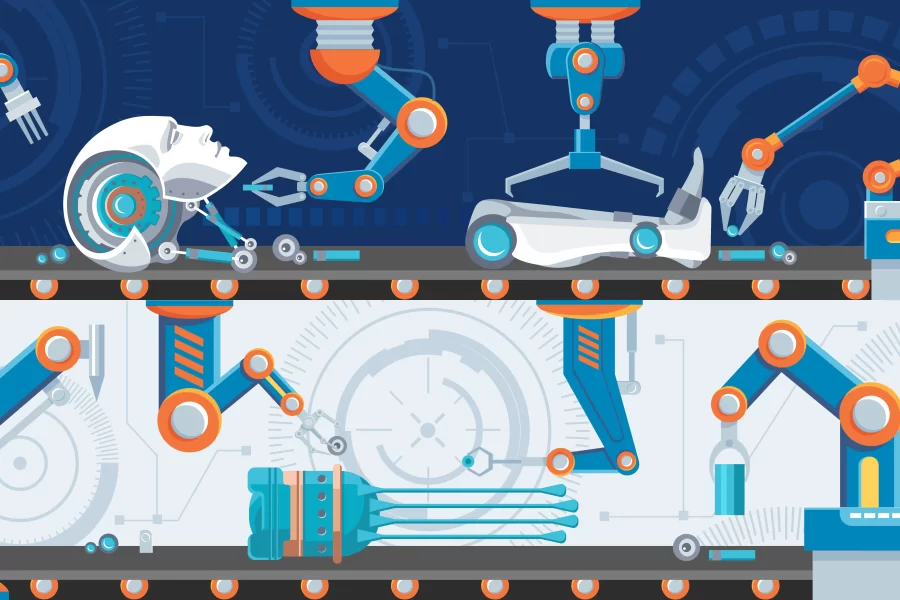
From the first steps of the industrial revolution to the present day, the change on production lines has been not just an acceleration of machines, but a profound transformation of mindset. From Industry 1.0, dominated by steam power, to Industry 4.0, where digitalization and automation reached their peak, robots served as mechanical arms alleviating heavy workloads. Today, we are facing the Industry 5.0 process, which combines human creativity with the precision of machines. In this evolution, robots have transformed from machines performing simple, repetitive tasks into intelligent partners that collect data, analyze it, and work side-by-side with humans. As Sora Robotic, we blend this technological heritage with over 40 years of sectoral experience to carry your production processes to future standards.
What is the Turning Point in the Evolution of Industrial Robots? A Journey from 1961 to Today
The foundations of robotic transformation on the production line were laid with the first manipulators carrying heavy parts. At that time, systems only undertook tasks that were repetitive and physically grueling for humans. However, as technology progressed, these systems took on different kinematic forms such as Cartesian, SCARA, and articulated arm structures. This diversity, which we also see in Sora Robotic solutions, arose from the necessity to meet the unique needs of every production line. Today, we no longer work with machines that just “carry,” but with those that “see and decide” thanks to vision systems and sensitive sensors.
What Did Cobot Technology Change in Production? Balance of Safety and Flexibility
Traditional industrial robots usually have to work in isolation from humans behind massive cages. However, the need for flexibility in production processes introduced the concept of collaborative robots, or cobots, into our lives. Cobots share the same workspace as humans thanks to advanced force and torque sensors, maximizing occupational safety by stopping automatically upon any contact. This flexibility is an invaluable advantage, especially for businesses working in confined spaces or making frequent model changes. Sora Robotic’s Rocobot series cobot systems can be integrated into production within minutes using a “Plug-and-Play” logic without the need for complex engineering processes.
Which Robot Type Should Be Chosen for Productivity Increase? ROI-Oriented Approach
When investing in robotic automation, the return on investment (ROI) is the most critical criterion, not just the speed of the machine. While traditional industrial robots stand out with speed and power advantages in large facilities where high-volume, uniform tasks are performed, cobots are much more profitable for SME-level companies or firms with variable business processes. At this point, the CNC automation and palletizing systems offered by Sora Robotic aim to minimize error rates by reducing the manual workload. Remember, robots do not get tired, do not take breaks, and can increase production output by up to 40% by working with the same precision 24/7.
Are Lights-Out Factories Becoming a Reality? The Dark Future of Production
“Lights-out Manufacturing,” which entered our lives with Industry 4.0, describes autonomous sites where human intervention is reduced to zero. In these systems, every stage from raw material delivery to the shipment of the finished product is managed by robots and AGV/AMR type autonomous vehicles. Robots do not need light, heat, or air conditioning; this provides massive savings in energy costs. These smart factories, which are also part of the Sora Robotic vision, are equipped with AI and big data analytics, enabling them to detect anomalies within seconds and optimize their own processes.
How Industry 5.0 and AI Make Production Human-Centric?
The future is not a place where machines completely exclude humans; it is the Industry 5.0 era where human creativity and robot precision are synchronized. Thanks to the integration of Large Language Models (LLM) and Artificial Intelligence, it is now becoming possible to communicate with robots in natural language and define tasks for them with voice commands. In this new era focused on by innovative actors like Sora Robotic, robots are no longer just tools, but “production partners” that enhance human capabilities. This transformation will allow the workforce to focus on more qualified tasks while bringing social welfare and sustainable production.
How Does Using Robots in Industry Increase Efficiency? Expert Perspective
In the success of a business, production efficiency, cost management, and maintaining quality standards play a vital role. Monotonous and tiring tasks that distract humans can be performed 24/7 without interruption and without millimeter deviation thanks to robots. The integration of robotic systems minimizes error rates while significantly reducing raw material waste. Using robots especially in dangerous environments involving high temperatures or chemical risks takes occupational safety to the highest point. This transformation not only ensures that your employees move away from tasks requiring only physical strength but also encourages them to take on more strategic roles such as planning, coordination, and management.
What Are the Differences Between Industrial Robots and Cobots? Guide to Choosing the Right System
When deciding on the right automation solution for your business, you need to understand the fundamental differences between traditional industrial robots and collaborative robots (cobots). Industrial robots are typically massive systems that work behind safety cages, requiring high speed and heavy load capacity. On the other hand, cobots can share the same workspace with humans without requiring any barriers thanks to their advanced sensors and lightweight structures. Expert note: The biggest advantage of cobots is that they can be reprogrammed within minutes, even by personnel with limited engineering knowledge. If you have a production line where frequent model changes are made and flexibility is more important than speed, the cobot solutions within Sora Robotic will be a cost-effective and agile starting point for you.
How AI and 5G Technologies Shape the Future of Production?
The future of robot technology is being shaped not just by mechanical movements, but by the “decision-making” capabilities of these machines. Thanks to the integration of AI and machine learning, modern robots can perceive their environment and provide proactive responses to unexpected situations. The low latency provided by 5G technology allows robots to share data within milliseconds, paving the way for smart factories and autonomous production processes. In this new era, the concept of “lights-out factories,” where machines operate fully autonomously without requiring light or climate control, is ceasing to be a dream and becoming a market standard.
What Should You Consider When Investing in Robotic Automation for Your Business?
In the process of transitioning to automation, simply purchasing a device is not enough; a proper needs analysis and return on investment (ROI) calculation are essential. Although the initial investment cost may seem high, the energy savings, increased production speed, and falling operational expenses provided by robots provide significant gains in the medium term. As Sora Robotic, we stand by you throughout the entire process from the discovery phase to simulation, installation, and after-sales support, ensuring that systems are seamlessly integrated into your existing infrastructure. Remember, automation is not a one-time project, but a long-term growth strategy that requires continuous improvement. Working with the right robotic partner adapts your business not just to today, but to the competitive production language of the 21st century.