Robotic Automation: How to Gain Competitive Advantage in Industry 4.0 The Fourth Industrial Revolution, known as Industry 4.0, is fundamentally transforming production and business processes—it’s no longer a secret. Today,...
Robotic Automation: How to Gain Competitive Advantage in Industry 4.0
The Fourth Industrial Revolution, known as Industry 4.0, is fundamentally transforming production and business processes—it’s no longer a secret. Today, not only large global corporations but also small and medium-sized enterprises (SMEs) must adopt robotic automation systems to improve workflows and gain a competitive edge in the global market. At the core of this transformation are advanced technologies that increase efficiency, minimize errors, and optimize resource utilization.
Robotic automation is one of the most effective ways to increase production speed and reduce costs. These systems eliminate human error in manual tasks, enhancing customer satisfaction and loyalty. Furthermore, employees are freed from tedious, repetitive, or hazardous tasks, allowing them to focus on more creative and value-added activities.
What Are Industrial Robots and Types of Robotic Automation?
Not every device associated with robotic automation is actually a robot. A robot is a mechanism that operates autonomously or via pre-programming, interacts with its environment, and performs assigned tasks. Robots possess sensing, data collection, planning, and actuation capabilities.
Robotic automation is generally categorized into two main branches, which must be clearly distinguished:
What Is the Difference Between Robotic Process Automation (RPA) and Traditional Automation?
While often confused with large, physical robot arms, Robotic Process Automation (RPA) is a completely software-based solution. RPA automates high-volume, repetitive, rule-based digital tasks. Software “robots” mimic human actions, performing tasks such as checking emails, issuing invoices, copying and pasting data, and more, flawlessly 24/7. In industries like banking and accounting, RPA automates monotonous, repetitive office tasks previously done by humans.
In contrast, Industrial Automation involves the collaborative operation of humans, machines, and robots in production processes.
Industrial Robots and Collaborative Robots (Cobots): Who Are They For?
Traditional industrial robots are typically large, occupying significant floor space. They are used in high-speed, high-precision operations such as welding, assembly, and heavy material handling. Due to their operation principles, these robots are usually enclosed in safety cages to protect human workers.
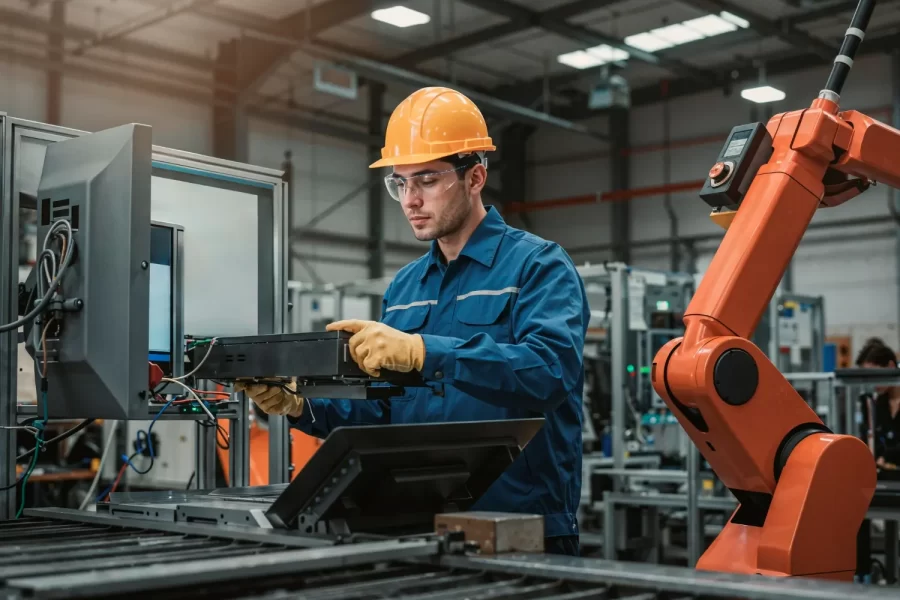
Collaborative robots (cobots), however, are ideal for SMEs. They can safely work alongside humans, are compact and lightweight, easily transportable, and suitable for tasks such as light assembly, sanding, packaging/palletizing, or quality control. Depending on risk assessments, cobots often operate without the need for safety barriers.
Why Are Production and Service Industries Rapidly Adopting Robotic Transformation?
Adopting robotic automation is not merely a technological trend; it is a strategic necessity to remain competitive.
What Are Robots Doing in Automotive, Textile, and Logistics Industries?
- Automotive Industry Leadership:
The automotive sector was among the first to adopt robotic systems. Industrial robots handle fast, precise assembly of heavy components. For example, a car assembly may involve over 5,000 welding points, and robots perform these operations faster and with higher consistency than humans. Painting and finishing processes are also robotized to ensure uniformity.
- Autonomous Mobile Robots in Logistics and Healthcare:
Autonomous Mobile Robots (AMRs) play a crucial role in logistics and storage. AMRs can detect obstacles and determine optimal routes independently. For example, in the pharmaceutical sector, AMRs transport vaccine vials or trays from production lines to storage areas, supporting high-capacity, clean-environment logistics processes.
- Textile and Apparel Industry:
The apparel sector has long been labor-intensive, but automation is gradually emerging. Automatic fabric-cutting machines and sewing robots (e.g., Sewbo, LOWRY SewBot) accelerate production and reduce errors. However, due to fabric flexibility and constantly changing styles/sizes, full automation (over 95%) in garment manufacturing is still considered unfeasible.
How Is Robotic Automation Transforming the Labor Market? (Threat or Opportunity?)
The impact of technological developments on employment has always been debated, and concerns persist that automation may lead to mass unemployment.
Which Jobs Are at Risk, and What New Skills Are Required?
Automation does not affect all jobs equally. Robots inherently perform repetitive, standardized tasks that do not require creativity, intuition, complex decision-making, or empathy.
-
Most Affected Jobs: Routine manual jobs in manufacturing (machine operators, assembly line workers) and office work (repetitive data entry) are the most vulnerable, with potential employment reductions expected.
-
Polarization of Employment: High-wage roles in non-routine cognitive tasks (managers, professionals) are growing, while low-wage, service-based positions requiring face-to-face interaction remain.
-
Role of Robots: Robots do not eliminate jobs entirely; they free workers from repetitive tasks, allowing focus on more productive activities such as analysis, synthesis, and creativity.
To adapt, the workforce must acquire 21st-century skills: analytical and innovative thinking, effective learning strategies, creativity, originality, entrepreneurship, and the ability to design and program new technologies.
Challenges and Safety Considerations in Implementing Robotic Automation Systems
While robotic automation offers significant benefits, it also involves high costs and substantial risks—both technical and ethical.
How to Overcome High Installation Costs and Flexibility Challenges?
The initial cost of automated tools and equipment is high relative to unit costs. Additionally, R&D costs for robotic systems can be significant, and ROI may take time to realize. Flexibility is also a challenge: in industries like apparel, where styles and sizes change rapidly, robots often require manual reprogramming for new tasks.
Physical Safety Standards in Industrial Robot Use
Safe robot applications require risk assessments by technical safety experts—remember, there is no “safe robot,” only “safe robot application.” Key safety standards include EN ISO 10218-1: Robots and EN ISO 10218-2: Robot Systems and Integration.
-
Physical Barriers: Moving parts must have fixed or movable guards (EN ISO 14120).
-
Stop Performance: Safety equipment like light curtains and area scanners must ensure proper stop performance (ESPE measurement).
-
Speed Limitation: If humans enter a robot’s teaching/programming area, robot speed must not exceed 250 mm/s.
How Do Cybersecurity Risks Threaten Production Lines?
With Industry 4.0, robotic systems are increasingly network-connected, raising cybersecurity risks. Unauthorized access to robot control software can cause equipment malfunctions or physical damage. Threats include ransomware, phishing, and insider attacks.
-
Network Isolation: Robotic systems should operate on networks separate from general IT infrastructure.
-
Access Control: Multi-factor authentication should prevent unauthorized access.
-
Training: Employees should receive regular education on social engineering and data security.