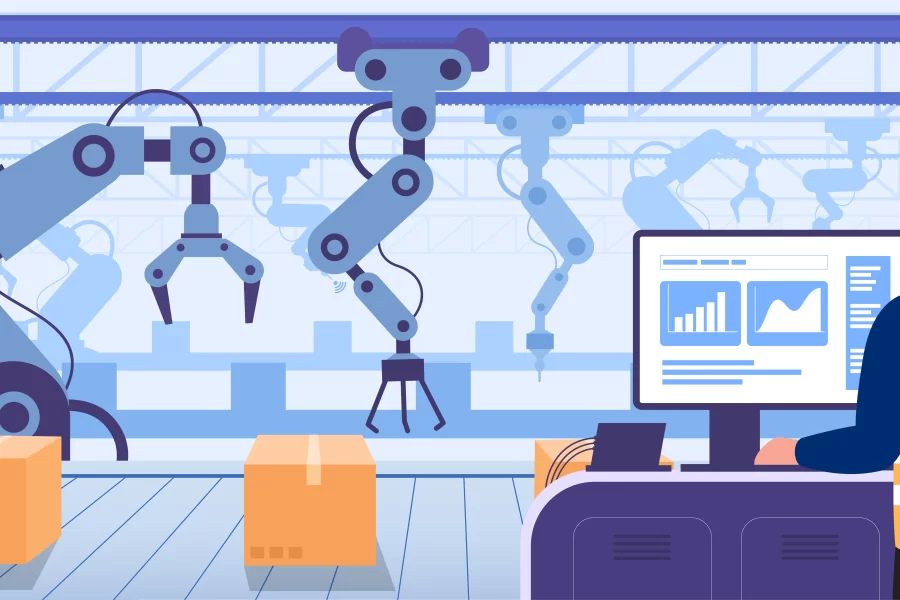
Industrial Robots and Robotics Technologies: What They Are Robotics technologies are far more than just a tool for automation—they are the backbone of modern manufacturing and the Industry 4.0 transformation...
Industrial Robots and Robotics Technologies: What They Are
Robotics technologies are far more than just a tool for automation—they are the backbone of modern manufacturing and the Industry 4.0 transformation itself. Based on my experience, I can confidently say that for a company to gain a competitive edge globally, it must integrate the speed, repeatability, and safety offered by these machines into its business processes.
Robotics is a multidisciplinary field encompassing mechanical engineering, electronics, and software components. The use of industrial robots is not a new concept; the first examples appeared in 1959, initially performing tasks like material handling in factories of major companies such as General Motors. Today, however, robots are much smarter and more flexible than those early mechanical giants.
Traditional Industrial Robots: Definition and Main Areas of Application
So, what makes a machine an industrial robot? The definition is standardized. According to ISO 8373, an industrial robot is an automatically controlled, reprogrammable, multipurpose manipulator with three or more programmable axes. These robots can be mounted either on a fixed location or a mobile platform and are used in various industrial automation applications.
Traditional industrial robots are generally designed for high-volume production in industries such as automotive, aerospace, and consumer goods.
Why Are Industrial Robots Still Indispensable on Production Lines?
A robot’s role on the production line goes beyond simply mimicking human actions—it excels where human capabilities fall short.
The core reasons industrial robots remain indispensable are their high speed, precision, and remarkable repeatability. Robots can perform the same task tirelessly, maintaining consistent quality every time. Tasks requiring high precision, repetitive operations, or activities that are hazardous to human health, such as welding, painting, or heavy lifting, can be delegated to robots. This reduces workplace accidents and increases production capacity.
Additionally, these systems eliminate human errors, ensuring consistently high product quality—critical for maintaining brand reputation.
Collaborative Robots (Cobots): How They Differ from Traditional Robots and Ensure Safety
Traditional industrial robots are heavy, fast, and potentially dangerous, so they usually operate in isolated cells, behind safety fences, light curtains, or locked doors.
In contrast, collaborative robots (cobots), whose popularity has grown rapidly in recent years, share workspaces with human operators, assisting and collaborating safely.
Key advantages of cobots include:
-
Ease of programming: Unlike traditional robots, cobots can be taught and programmed by any operator with minimal training, eliminating the need for specialized programmers.
-
Flexibility: Cobots allow SMEs (Small and Medium Enterprises) to quickly adopt automation solutions.
Cobots are commonly used for low-skill, repetitive tasks such as machine loading/unloading, part handling, simple assembly, and quality control.
Human-Robot Interaction: Cobot Safety Standards (ISO/TS 15066 and PL/SIL)
The philosophy behind cobots is safety and security. Physical interaction between the robot and operator is central to their design, and built-in safety features minimize potential hazards.
ISO/TS 15066 specifies guidelines for collaborative work, detailing force and speed limitations. If a cobot comes into unexpected contact with a human, it must apply limited static and dynamic forces, triggering an immediate stop.
Safety performance is evaluated according to criteria such as Performance Level (PL) and Safety Integrity Level (SIL), typically in accordance with EN ISO 13849-1. Control systems within robotic cells may also need to meet Category 3, PL d requirements as recommended by EN ISO 10218-2.
During risk assessment, factors like robot speed, operator proximity, and stopping time are carefully calculated.
The Future of Robotic Systems in the Industry 4.0 Era
Industry 4.0 involves the integration of digital technologies—AI, IoT, and big data—into industrial processes. This transformation is driving robotics toward smarter, more autonomous, and more flexible systems.
-
AI and machine learning integration enables robots to analyze real-time data, sense environmental conditions, and adapt quickly to changing situations. Robots are no longer limited to repetitive movements—they can make autonomous decisions in complex tasks.
-
Sensor technologies play a critical role. Motion, optical, pressure, and positioning sensors allow robots to perceive and analyze their surroundings.
-
5G and IoT integration keeps robots continuously connected to cloud systems, allowing them to handle large data streams with low latency.
The combination of these technologies leads to smart factories, where machines and automation lines communicate seamlessly. Predictive maintenance systems identify potential failures in advance, ensuring uninterrupted production.
Robotic systems thus not only enhance efficiency but also adapt to customized and variable production demands. Continuous development in robotics, emphasizing human-robot collaboration, is shaping the future of manufacturing.