Robotic Applications: How Are They Revolutionizing Industries Worldwide? Robots are no longer just a subject of science fiction; they are practical solutions permeating every aspect of our lives, from factories...
Robotic Applications: How Are They Revolutionizing Industries Worldwide?
Robots are no longer just a subject of science fiction; they are practical solutions permeating every aspect of our lives, from factories to healthcare, homes to outer space. This article will comprehensively explore the wide spectrum of robotic technologies, their benefits, and their future potential across diverse fields.
What are the Core Dynamics of Successful Robotic Applications?
Robotic applications involve the use of robots to perform a specific task or a series of tasks. The effectiveness of these applications depends on the robot’s design, programming, and its integration into the broader system.
A successful robotic application typically relies on these fundamental dynamics:
- Task Definition and Analysis: Clearly defining the problem the application will solve, the tasks it will automate, and the expected outcomes is essential.
- Robot Selection: Choosing the appropriate robot type (e.g., industrial arm, mobile robot, humanoid robot) based on the task’s requirements for payload capacity, degrees of freedom, and precision.
- Environmental Interaction: Considering the robot’s operating environment, safety requirements, and its interaction with other machines and humans. Sensors (e.g., vision, force, proximity) enable this interaction.
- Programming and Integration: Developing the robot’s software correctly and integrating it seamlessly into existing systems (e.g., production lines, ERP systems) is paramount for execution.
- Flexibility and Adaptability: The ease with which the application can adapt to future changes or new requirements is crucial for its long-term success. Applications supported by Artificial Intelligence (AI) and Machine Learning (ML) particularly excel in this regard.
The development process usually involves the collaboration of teams specializing in engineering, software development, and system integration. Simulation software, prototyping, and rigorous testing ensure the application is optimized before deployment.
Which Industries Are Most Transformed by Robotic Applications?
Robotic technologies play an active role in many different areas of our lives today. They provide significant societal benefits across various sectors.
Here are examples of robotic applications across major sectors:
- Industrial Manufacturing and Automation: This is the most well-known area for robotic applications.
- Welding and Assembly: In automotive, electronics, and metal industries, robots perform consistent, high-quality welding and precisely assemble complex parts.
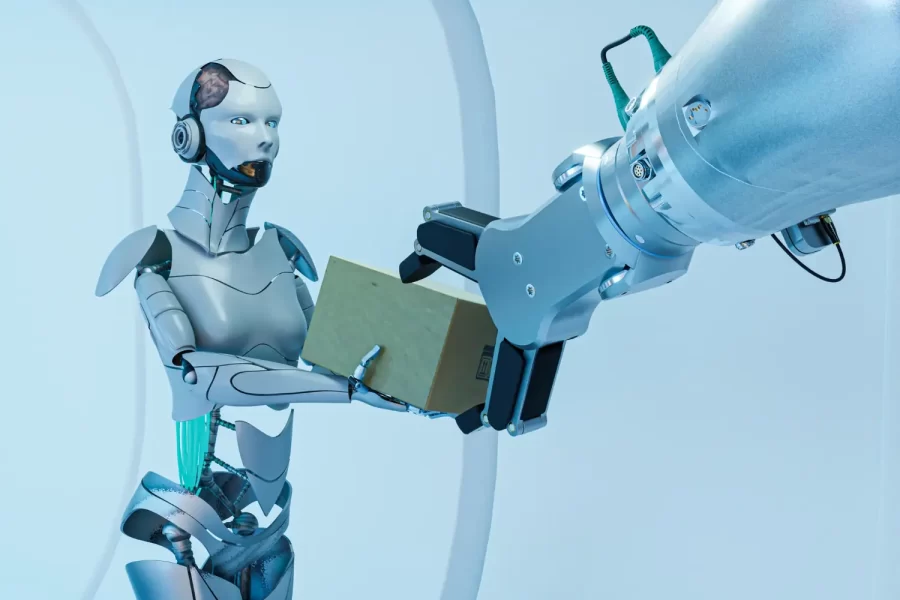
- Material Handling and Logistics: Robotic arms and Autonomous Mobile Robots (AMRs) handle picking, sorting, and palletizing products in warehouses and factories, significantly improving efficiency.
- Surface Treatment and Painting: Robots ensure even and smooth surface quality for tasks like painting car and aircraft parts, reducing material waste.
- Healthcare and Medicine: Robots are used in a wide range of applications, from surgical operations to patient care.
- Drug Dispensing and Lab Automation: Robots in hospitals dispense medications or automate sample analysis in labs, reducing error rates and improving efficiency.
- Service and Retail: Robotic solutions offer various services.
- Delivery Robots: They facilitate last-mile logistics by delivering packages or food in urban areas.
- Agriculture and Food: Robots are used to increase agricultural productivity and automate food processing.
- Food Processing and Packaging: Robots assist in cutting, packaging, and quality control of food products
These applications lead to reduced operational costs, increased production capacity, reallocation of human resources to more strategic areas, and overall enhanced competitiveness.
What Does the Future Hold for Robotic Applications and Their Challenges?
The future of robotic applications is being shaped by the integration of AI, advanced sensor technologies, and more flexible hardware.
Key areas where robotic applications are expected to grow include:
- More Advanced Human-Robot Collaboration (Cobots): In the future, robots will interact with humans more naturally and safely, performing joint tasks. This will make automation more accessible, especially for small and medium-sized businesses.
- Smart Cities and Infrastructure: Autonomous robots will play a greater role in traffic management, waste collection, security surveillance, and infrastructure maintenance.
- Personal Service Robots: More sophisticated and accessible robots will emerge in areas like elder care, child education, household chores, and personal assistance.
- AI-Powered Decision Making: Robots will be able to make more autonomous decisions in complex scenarios, solve problems, and adapt to uncertain situations, creating a wide impact from logistics to disaster management.
However, alongside these advancements come significant challenges and ethical concerns. Issues such as job displacement concerns, data privacy, accountability in autonomous systems, ethical principles in robot decision-making, and the psychological effects of human-robot interaction are crucial topics that must be carefully addressed as these technologies develop.
Robotic applications offer intelligent solutions for today and tomorrow, holding the potential to enhance societies’ quality of life and transform industrial processes. The proper and responsible development and integration of these technologies are critical for human progress.